Room Party
Room Party is a peculiar take on adding digital chat and profiles to a local in-person event. I built it to test a theory that mediated communication can be extremely useful at small scale, and that a lot of what we take for granted on hyperscaled "social media" platforms is designed to compensate for the fact that we're trying to talk to each other but are forced into public by the needs of advertising.
Room Party facilitates pseudonymous chats. You say who you are, it takes you at your word, and then it lets you talk to others. It doesn't verify your "real" identity in any way. There are no accounts, no registration, no servers, no internet and no notifications. Your phone only talks to other phones within short Bluetooth range, and only while the app is open. It's loosely based on Nintendo's StreetPass, using Bluetooth Low Energy the way Bitchat does.
Trust someone on Room Party as much as you'd trust what's written on their con badge, no more and no less.
My shorthand for the design is "polite, not secure." "Events" are chatrooms that dissolve forever once everyone has left. Comms are encrypted. You can block people and hide events you don't want to see. That said, none of this is built as a secure messaging app. Do not share state secrets (or your home address!). Treat everything you share as if it was said in a common space, the way you would at a room party where you don't really know everyone yet.
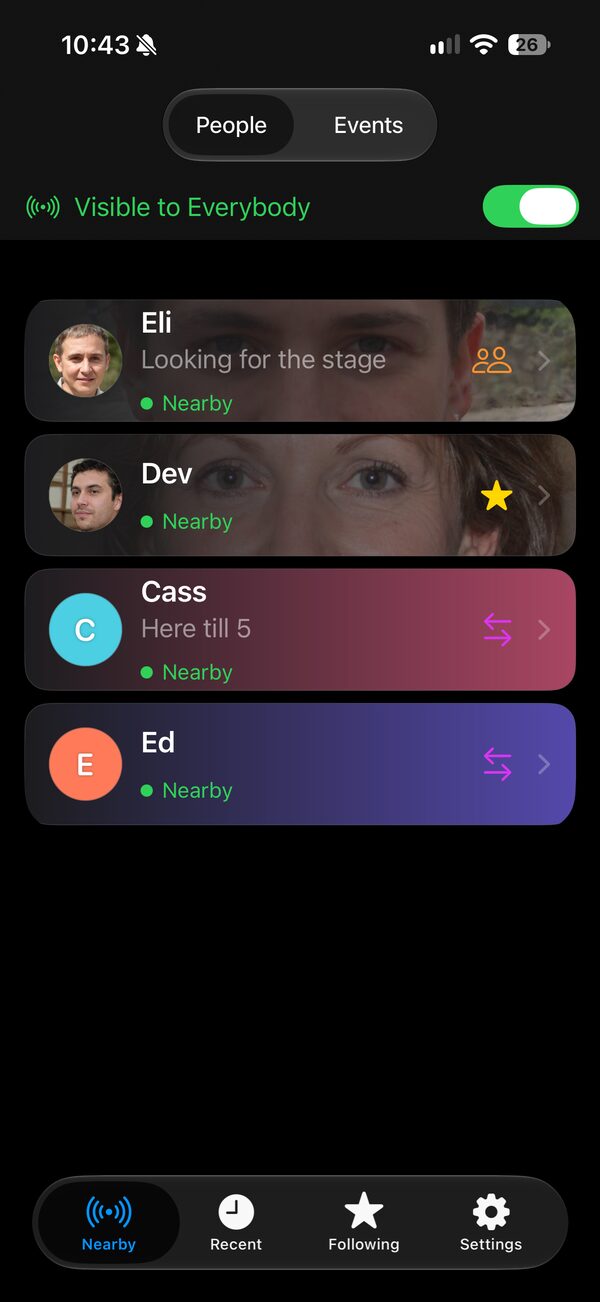
"Nearby"
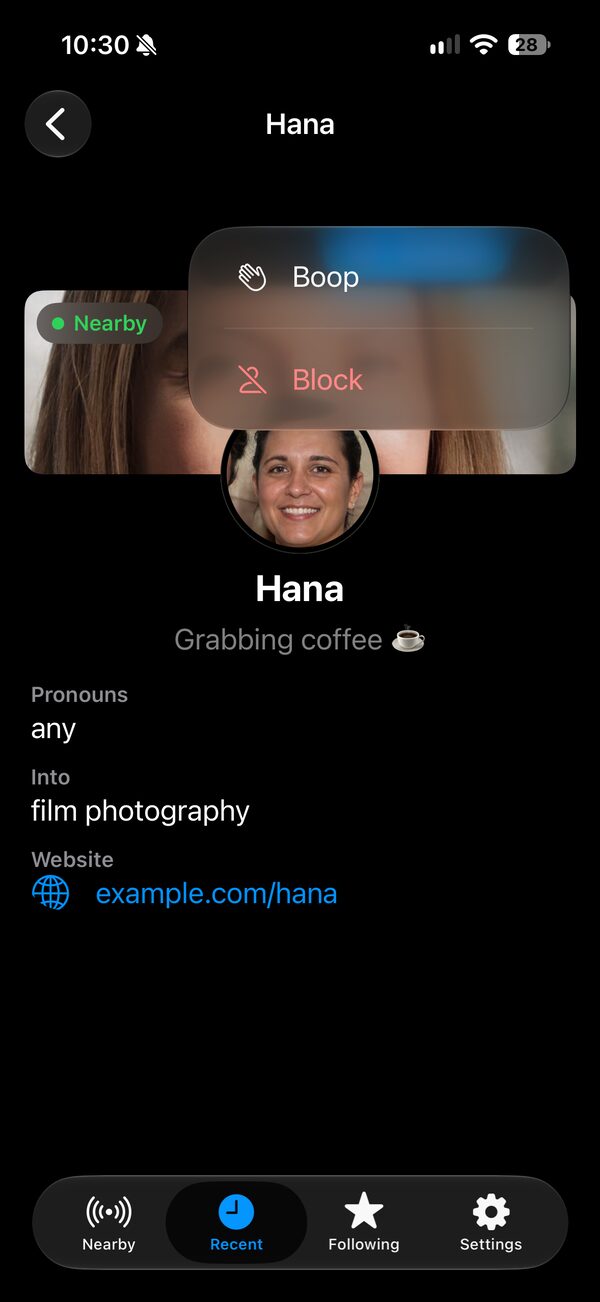
Open the app and give yourself a name (you can change it any time). Everyone nearby who is also running the app shows up, with a green dot while they're in range. Tap someone to see their profile: their banner, photo and status, plus whatever fields they chose to share with you.
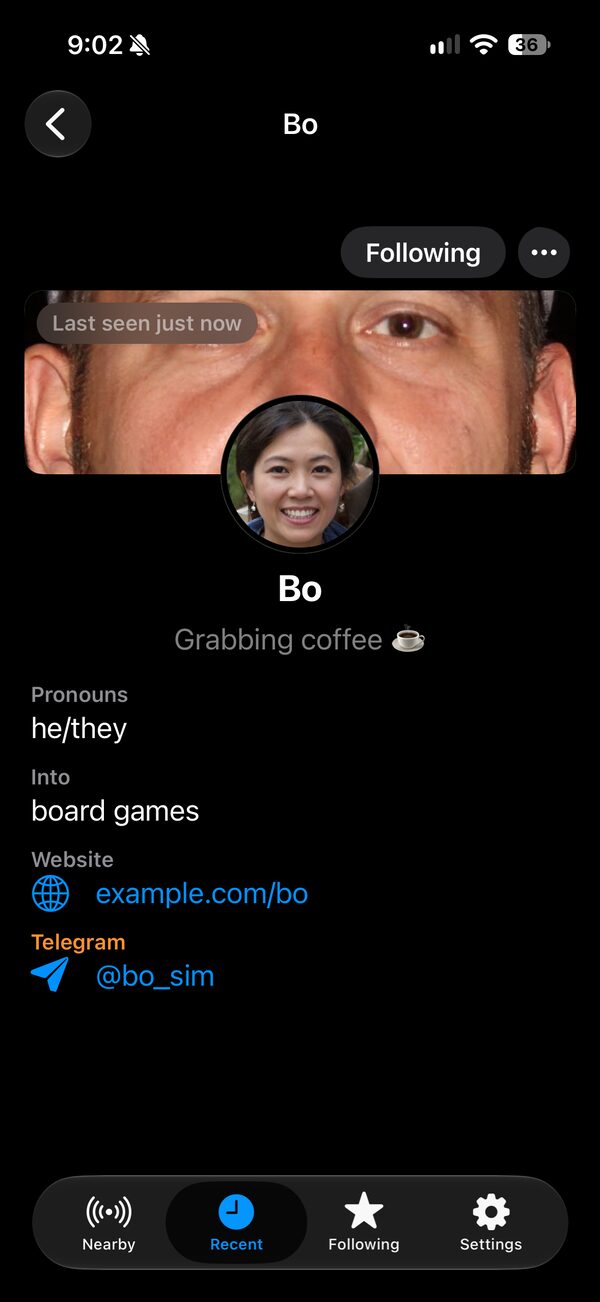
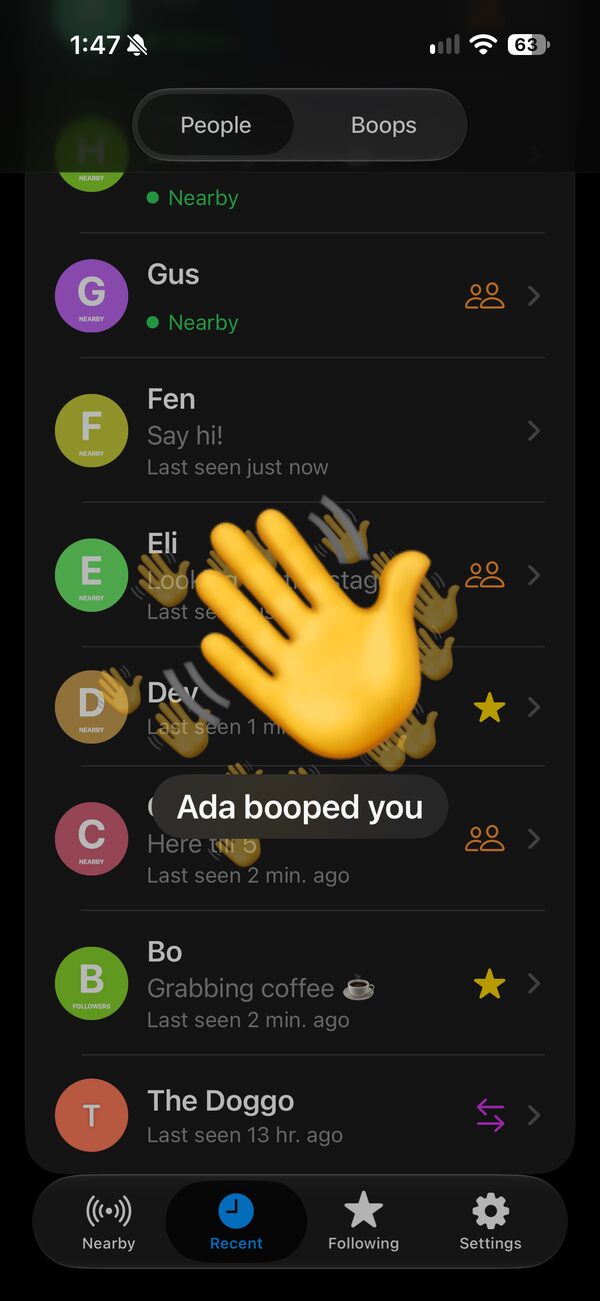
Profiles you encounter stay under "Recent" for a day. You can "Follow" someone to bookmark their profile and keep it under "Following." If they follow you back, you're mutuals.
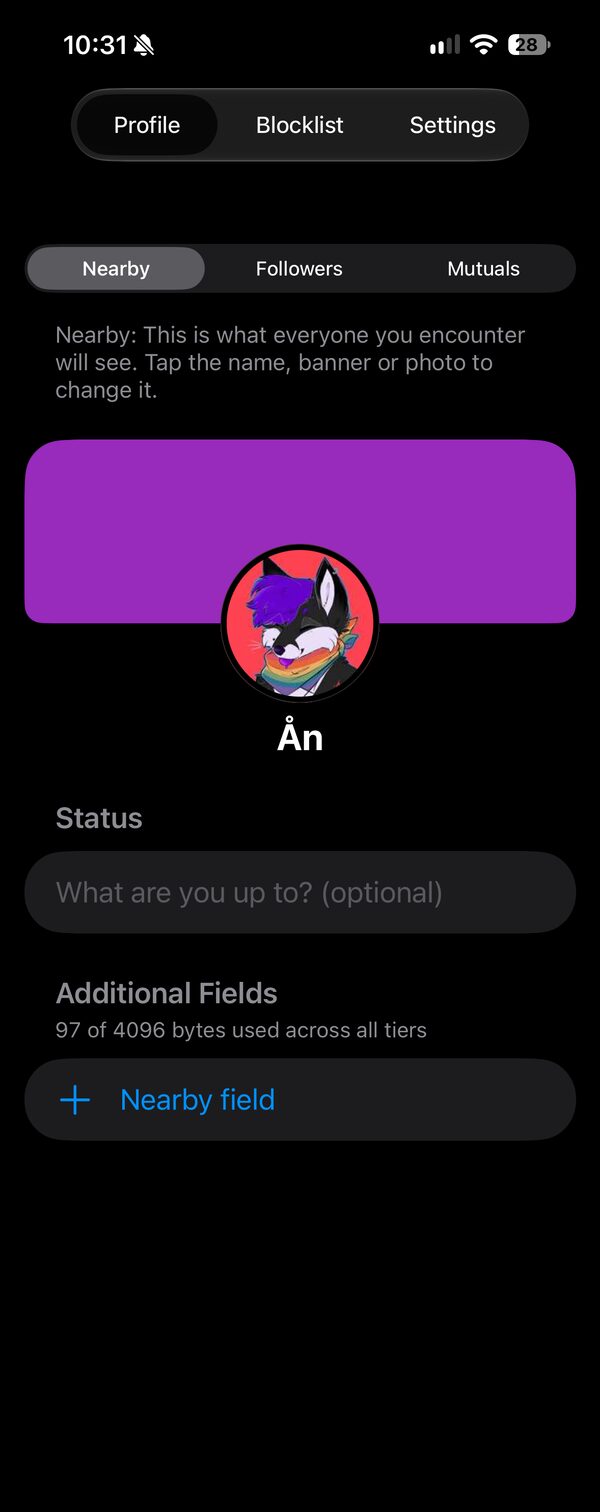
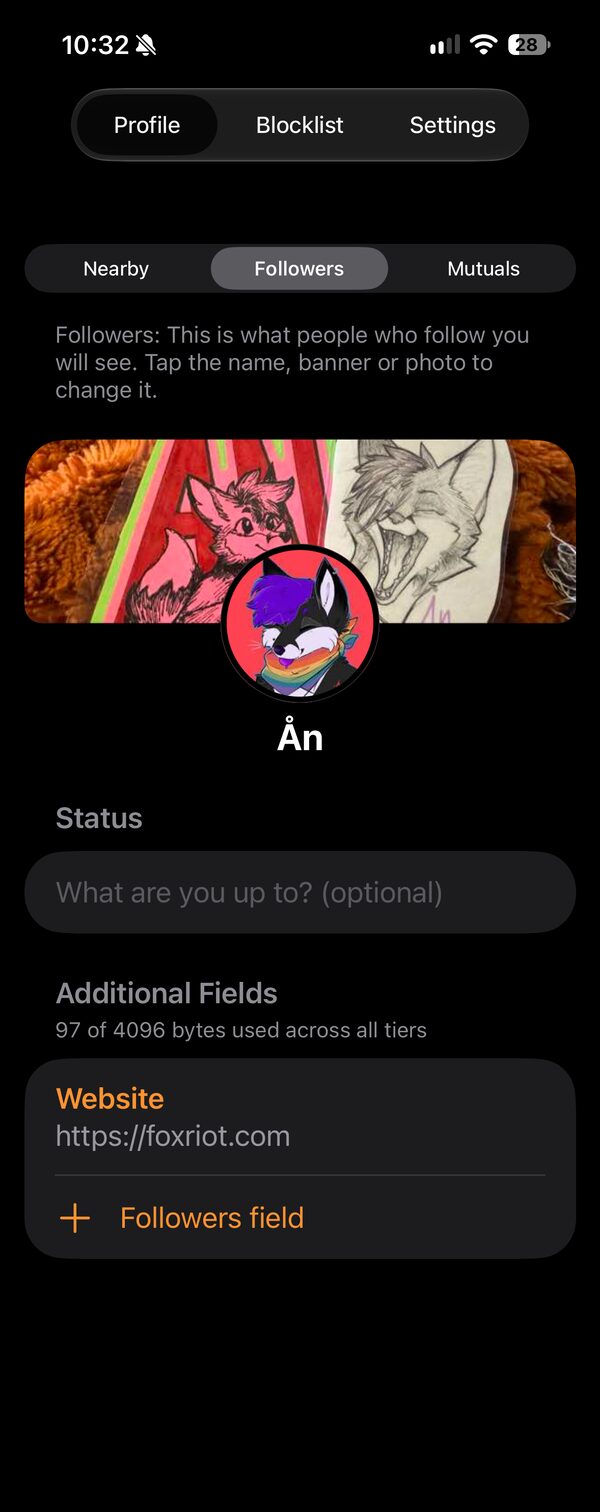
Three versions of your profile
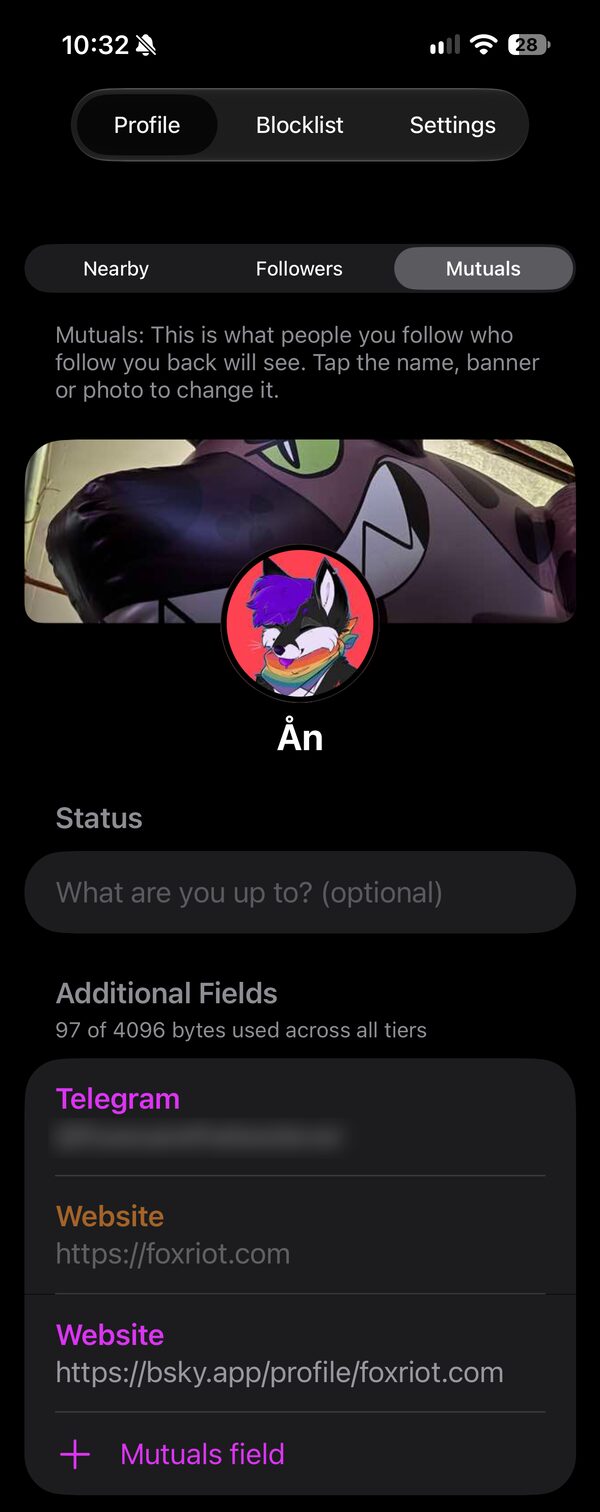
You can show different fields to different audiences. Your name stays the same, but you fill in three tiers:
- Nearby: visible to everyone you pass.
- Followers: visible only to people who follow you.
- Mutuals: visible to people who follow you and whom you follow back.
For instance, you might show strangers a plain color, show followers your real face, and give your Telegram handle only to mutuals.
Events
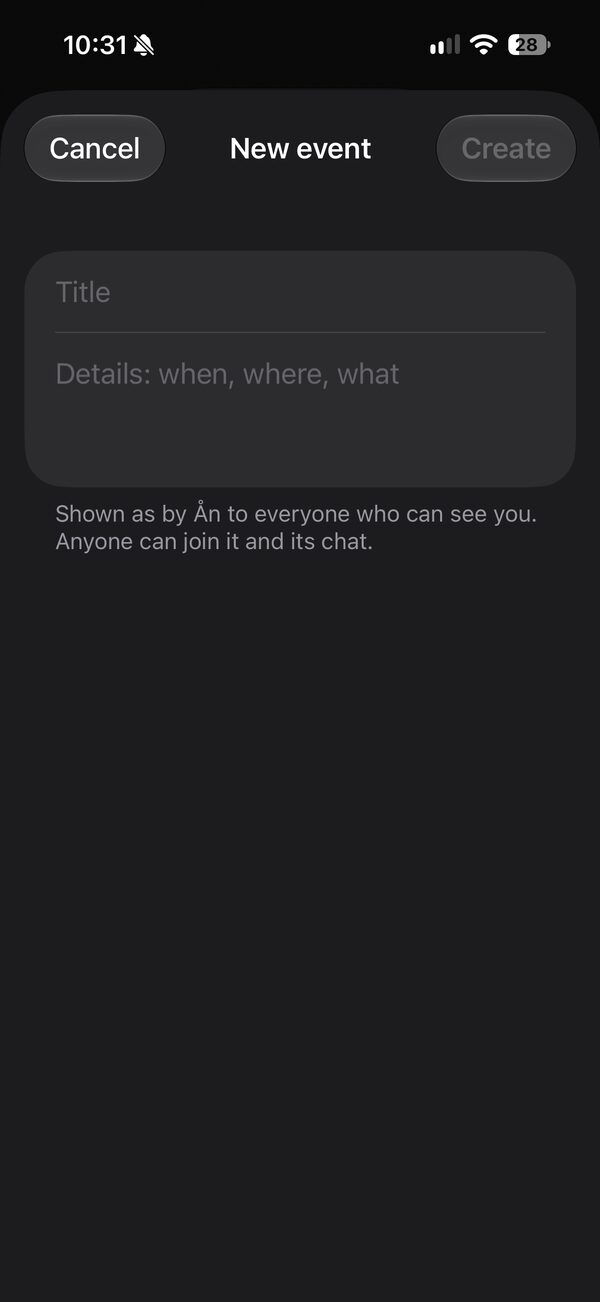
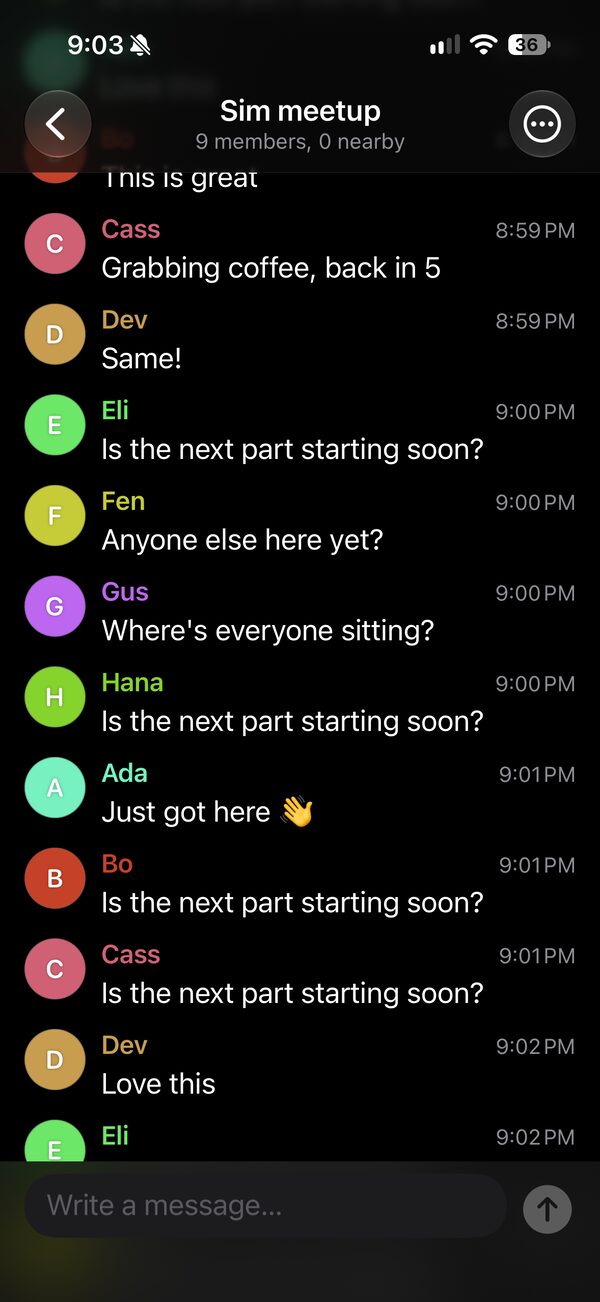
When you create an event, everyone who can see you can see the event too. Joining an event opens a shared group chat. Members pass each other's messages along as they move around the room, so a message reaches everyone even though every link is phone to phone. Each message carries its author's signature, and the phones relaying it can't forge or change it. The creator can ban people, and once the creator leaves, the event closes and is gone forever.
Boops
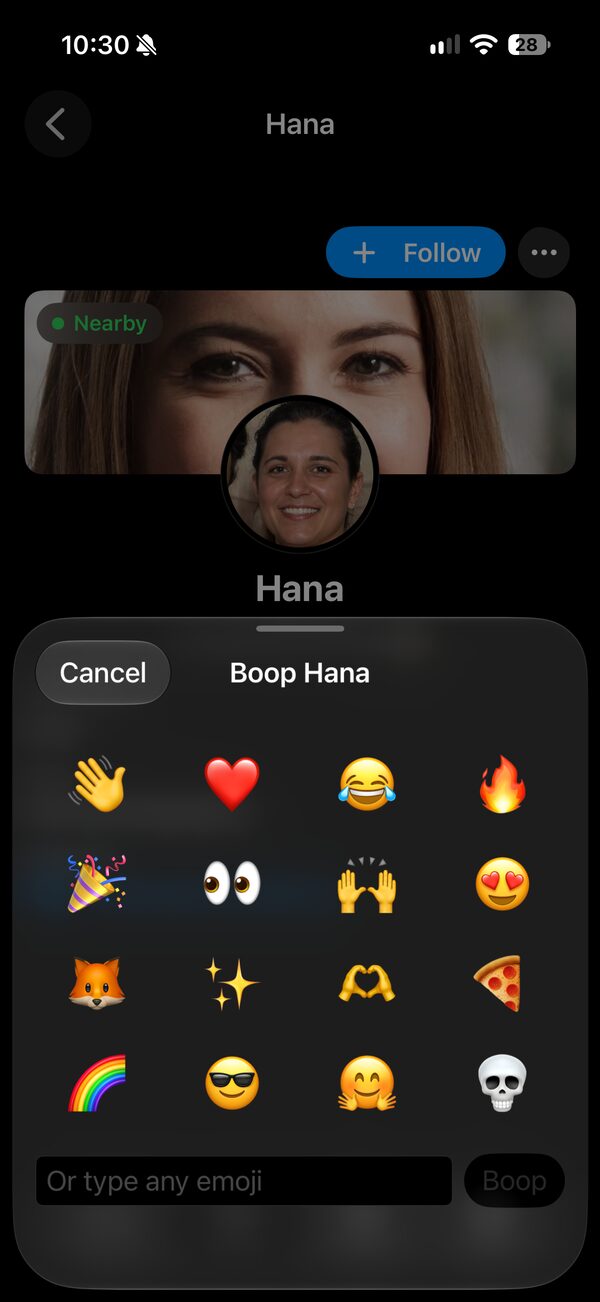
You can "boop" someone nearby with an emoji. You choose who's allowed to boop you: everybody, mutuals or nobody.
Nerdy Stuff (How it Works)
Every phone both advertises and scans over Bluetooth Low Energy. The advertisement only carries a service ID, so there's no name or profile data in it. When two phones find each other they connect, run an encrypted handshake, swap profiles and hang up. Your phone keeps what it received in a local database of the people you've encountered.
Bluetooth is slow (around 5 KB/s in practice) and people walk past quickly, so I kept everything small. A profile holds at most 4 KB of text, a 12 KB photo and a 24 KB banner. Your name and colors go first, so a cut-off encounter still leaves something recognisable, and half-sent images resume the next time you meet. A phone holds at most six connections at once and prefers people it hasn't met yet. That should keep a crowded room usable, but I haven't tested it yet!
The protocol
Each installation makes a long-term X25519 key pair on first launch, and your ID is the public key. The phone never broadcasts it, and only reveals it inside the encrypted handshake. That key is the app's unique fingerprint, so reinstalling the app gives you a new one.
Phones talk over a single Bluetooth characteristic, used as a byte stream. Every phone is both central and peripheral. If two phones end up connected to each other in both directions, they keep one link and drop the other. Each frame on the stream is a two-byte length followed by the bytes, split into whatever chunk size the link allows.
Every message starts with a one-byte type, and phones ignore types they don't know. Both sides open by saying whether they follow the other, which decides each one's tier. Then each sends a card (name, colors and image hashes) followed by the full profile, both rendered for that tier. The other phone requests images by hash and gets them in 16 KB chunks, with an offset so an interrupted download picks up where it left off. The sender orders its queue before encrypting anything: control messages go out first, then the card, the profile and finally images.
An event chat is a log of signed items. Two phones that share an event compare a short digest of what they hold, and only swap item lists when the digests differ.
Noise XX
Noise is a framework for building encrypted channels. WireGuard uses it, and so does WhatsApp between the app and its servers. Room Party uses Noise_XX_25519_ChaChaPoly_SHA256. In the XX variant neither side knows the other's long-term key in advance, and both send theirs during the handshake. Strangers meeting over Bluetooth don't know each other's keys either. It takes three messages:
- A sends a fresh, throwaway key.
- B replies with its own throwaway key, then its long-term identity key, encrypted with a secret derived from the two throwaway keys.
- A sends its identity key, encrypted the same way.
After that, both phones encrypt everything with ChaCha20-Poly1305, which also rejects any packet someone has tampered with. Identity keys only travel encrypted, so someone listening in can't tell who is talking to whom. Each side proves it holds the private key behind the identity it claims, so nobody can pose as someone you follow or slip past a block by borrowing someone else's identity. And since the session keys come from the throwaway keys, someone who later steals an identity key still can't decrypt anything they recorded earlier.
It doesn't stop someone from turning up with a brand-new identity, although then they'd have to rebuild any follower or mutual relationship from scratch. Say someone introduces themselves as "John," you become mutuals, and you run into each other again later. You can be sure it's the same device you talked to before, even if they've changed their presentation, but if they've rolled their identity key, they'll show up as a brand-new person.
None of this prevents someone from straight-up lying to you about who they are or impersonating someone else. The actual social proof is that they're in the same physical room as you.